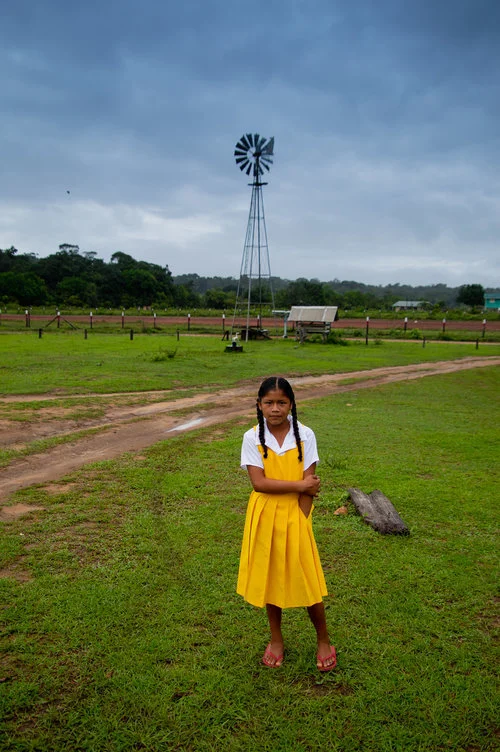
Amongst the calls of howler monkeys, the heat & humidity, and beautiful scenery, Guyana stood out most with its people. The Guyanese we met during the Earth Expedition field course (Miami University) all had varying capacities in their involvement with the conservation of their natural habitats but all understood the significant value of the natural resources provided to them in their daily life, cultural and natural histories, as well as in the development of Guyana’s Green Economy.
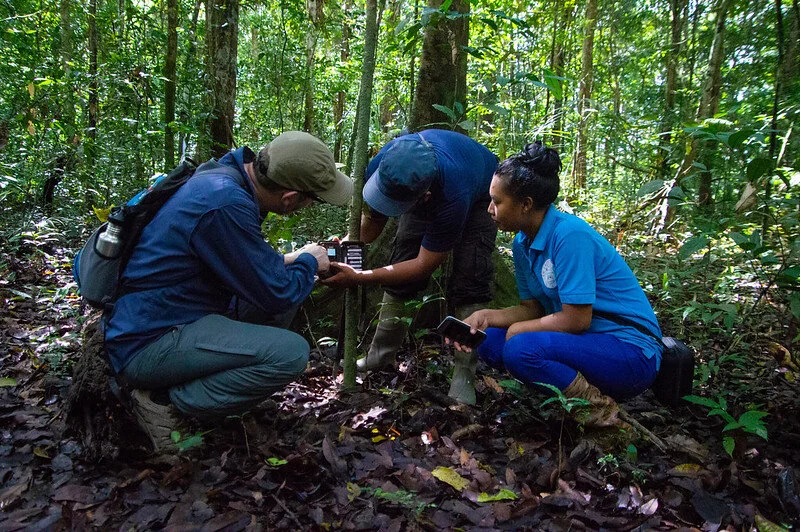
An Iwokrama International Centre park ranger sets up a camera trap with students from Miami University and the Bina Hill Institute.
While staying at Iwokrama International Centre, it was made evident that this nonprofit was very innovative and adaptive in its incorporation of scientific research, sustainable forestry, wildlife conservation, ecotourism, and the inclusion of local communities for the co-management of Iwokrama’s resources (Bellfield et al., 2015; Iwokrama, n.d.). During our stay at Iwokrama’s River Lodge, participating in camera trap studies along various forest trails and roads was particularly impactful for me as I hope to utilize them in my master’s plan in the future in Peru. When we worked with Iwokrama’s park rangers to set up and collect the camera traps, however brief it was, I had a great time as it incorporated hiking, tracking animal signs, and utilizing and learning from the local knowledge of the area in an effort to collect data successfully. During this very brief data collection, trumpeter birds, agoutis, and even an ocelot were caught on camera trap! In addition to these positive camera trap trigger events, we also found puma tracks and scrapes surrounding one site. These successes came largely in thanks due to the park rangers vast knowledge of animal game trails and regions the carnivores are often observed patrolling. Without this local knowledge, the likelihood of Miami University students successfully finding animals on camera trap would have been up to luck and randomness at best and having the opportunity to observe the rangers in practice was particularly beneficial to my goals within the Miami University Global Field Program.
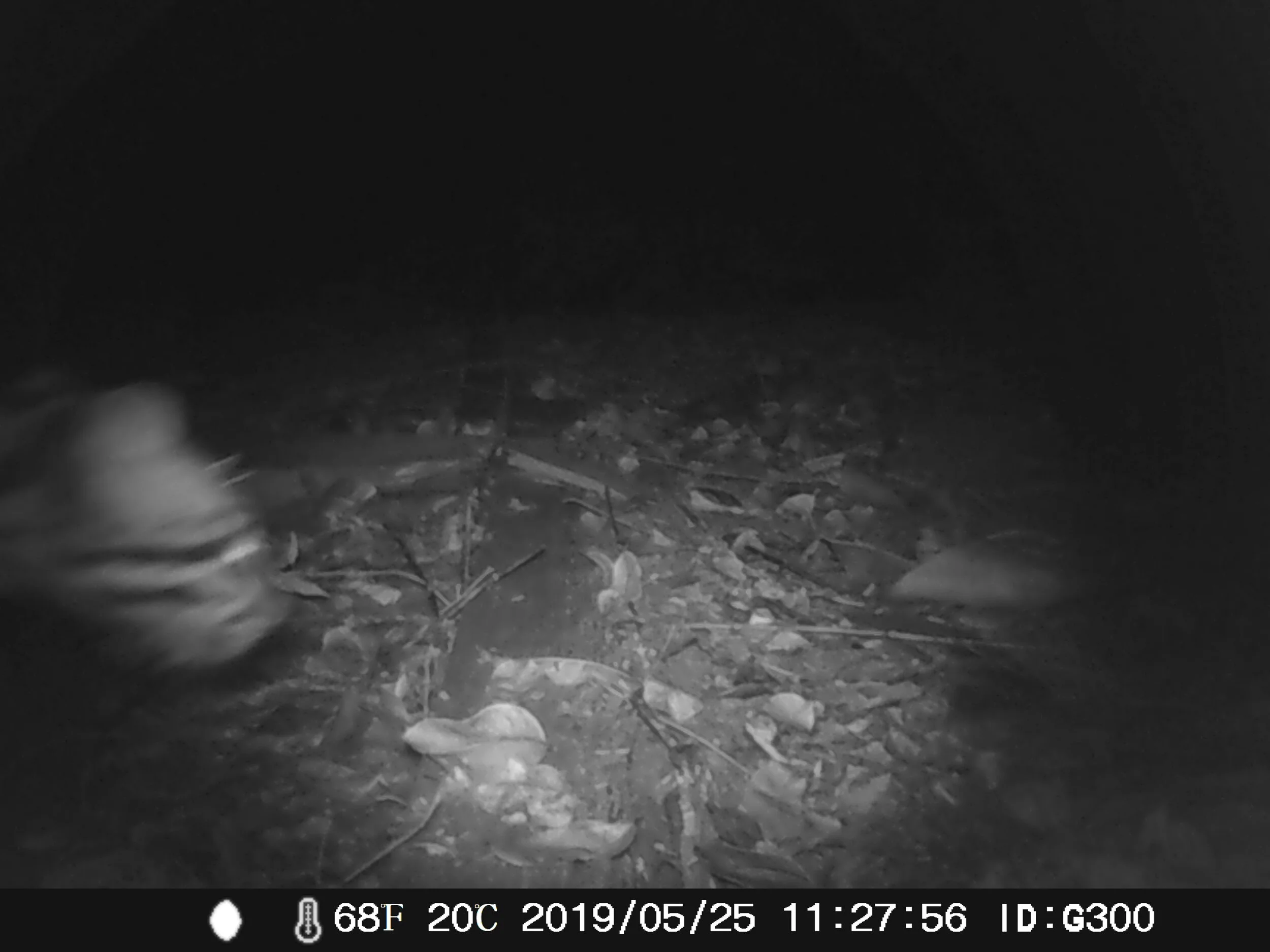
An ocelot comes into frame upon a camera trap set up within the Iwokrama International Centre’s forests.
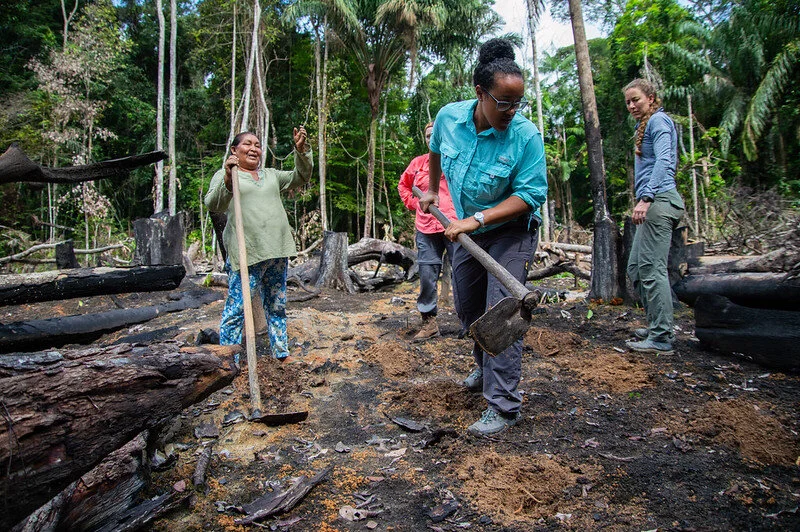
Auntie Paulette provides instruction to Miami University students in planting yucca.
During the stay at Surama Eco Lodge, two different experiences stood out as well. Working alongside Auntie Paulette and Uncle Dan, both Makushi descendants, on their sustainable plantation and seeing the efforts put into place to utilize the forests’ fertility while also allowing the forest to reclaim and heal the previously used plots was in direct contrast to what is practiced in the United States. This use of traditional ecological knowledge integrated within a local community’s economic system where fruits and vegetables can be sustainably harvested with minimal invasiveness to the environment is exactly the type of revolution needed in North American agriculture. In addition to seeing the sustainable forest clearing & forest reclamation, planting, and harvest of yucca, seeing the maximized efficient use of the yucca product was quite astounding. Later at the yucca processing plant, seeing the number of food products made from the root vegetable that naturally contains cyanide was a fantastic display of cultural knowledge at its best.
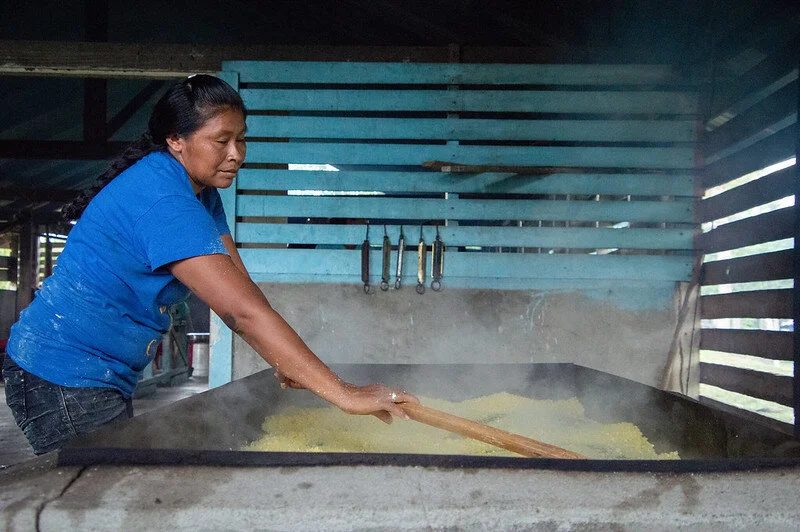
A worker at the yucca processing plant working hard on a giant frying pan to prepare farine to later be sold within the Surama community.
Long before modern forest science existed, indigenous community management of forests were in practice to sustain families and communities (Parrotta et al., 2016). Along the progression of western influence, mass production skewed sustainability for profit margins and threw concern for the environment by the wayside. Utilizing the knowledge, innovations, and practices from indigenous and local communities that have been refined over centuries and integrating them into post-modern forestry science and conservation efforts becomes a crucial step moving forward into preserving native ecosystem services and their benefits (Becker & Ghimire, 2003; Parrotta et al., 2016).
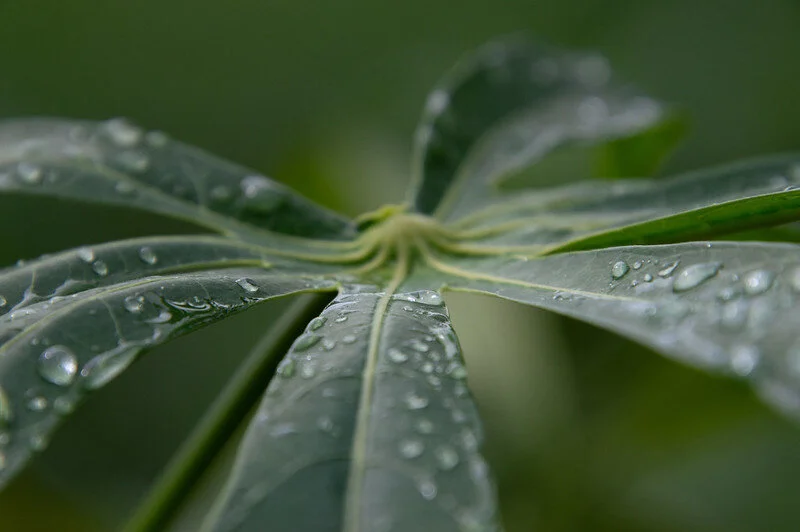
Rain droplets form on a yucca leaf.
-Adam Dewey, MA Biology, Miami University
Citations
Becker, C. D. & Ghimire, K. (2003). Synergy between traditional ecological knowledge and conservation science supports forest preservation in Ecuador. Conservation Ecology, V.8, No. 1.
Bellfield, H., Sabogal, D., Goodman, L., & Leggett, M. (2015). Case study report: Community-based monitoring systems for REDD+ in Guyana. Forests, V.6, No. 1, 133-156.
Iwokrama International Centre for Rain Forest Conservation and Development (n.d.). Retrieved from https://iwokrama.org.
Parrotta, J. et al. (2016). Traditional knowledge for sustainable forest management and provision of ecosystems. International Journal of Biodiversity Science, Ecosystem Services, & Management, V.12, Nos 1-2, 1-4.